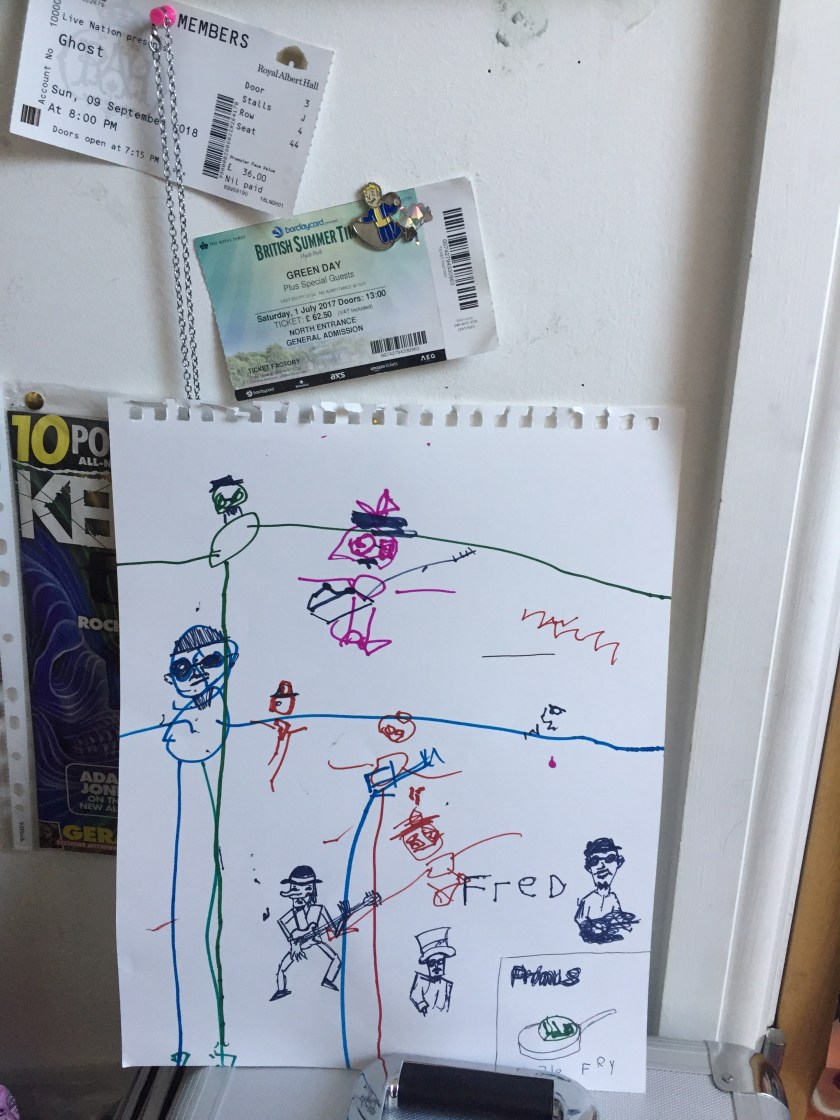
I never knew until today that four year olds possess the capability to draw Les Claypool and to tolerate his works alongside Primus. I was sat down at my desk doodling, then my brother Freddie comes upstairs asking why I’m playing music and calling it “weird”. He came over sat down and added to what I had started, I have a picture on my desk as I had just finished drawing Les properly and I think Fred picked up that he is tall…
He has started Primary School in September, ever since his vocabulary has expanded and hes beginning to understand what I tell him and what I am listening to, which is Primus most of the time so a part of me feels bad as he does not know what is going on especially when it comes to the music videos.
When it comes to any music that’s being played round the house by me and Harvey or in the car he always picks out the drums and keeps a steady beat with his head or feet, its hilarious but on the other hand it’s fairly impressive for a four year old. I am definitely going to keep on encouraging him towards music because all my other siblings so far have picked up an instrument or something musical.
Harvey picked up the bass when Ben joined school which is cool, hes picking it up fast and he’s trying to pick up guitar alongside learning theory with me, at the moment he is in year 9,
Jack has singing lessons at school which he enjoys and doesn’t let his autism get in the way of what he wants to do with himself, he’s currently in year 10 and working through his GCSE music with Ben,
Sadie has just started secondary school and has begun piano lessons in school with Ben’s influence through his engaging lessons which is great for her to try and push herself with,
Max is in year 5 at the moment and at the beginning of the new term he has picked up the clarinet with high hopes of progressing through to playing the saxophone when he gets the hang of it,
And finally we have Zach he is in year 2/3 I can’t recall, he hasn’t had any interest with any instruments, he is into technology and all that fun stuff so I am not too sure on what he wants to do, he isn’t a big fan of loud noise either so we shall see.
One of the most talented and electric bass players out there, Les Claypool, lost half his hearing in one ear during a diving accident in 1993. Les Claypool grabbed my attention more than a month ago with his fun take on finger tapping and flamenco style strumming in the band, Primus and his many other side projects like Colonel Les Claypool’s Fearless Flying Frog Brigade.
He mentions his hearing loss in an interview on JamBase.com:
“Moving back to you personally, I believe I read that you lost hearing in your left ear, is that correct?”
“In my right ear. Some of my high frequency from a scuba diving accident.”
“Does that affect your bass playing in any way?”
“Not really. It affects me socialising with large groups of people. It’s hard for me to discern syllables sometimes. Like if there are a lot of people talking, especially women’s voices, I just can’t hear. So I try to kind of aim my left ear at people.”
Within other interviews from two years ago whilst he goes on to explain about his own soft drink called SeaPop.
He then goes on to explain how the drink got its name and why it is what it is, The bass virtuoso says the drink is “like a ginger-snap dipped in vanilla ice cream” and that it’s here to “mellow things out in a world saturated with energy drinks.”
Claypool says: “Years ago I accidentally ruptured my inner ear scuba diving off the California coast and since that day I’ve found myself a bit more susceptible to the adverse effects of motion.
Considering all of the following that Les Claypool has experienced it’s important to learn from another musicians mistakes. As musicians, we spend long hours practising and improving our skills. While our polished musicianship is valuable, our sense of hearing is often overlooked as what it is—the essential and irreplaceable tool for music-making.
Many professional and aspiring musicians instinctively understand that they are at risk for hearing loss from lifelong exposures to loud music. Rarely discussed, however, is that the risk includes developing other hearing disorders such as constant ringing (tinnitus), degraded pitch perception (diplacusis), or intolerance of loud sounds (hyperacusis).
Practical solutions can reduce the risk of music-induced hearing disorders without compromising the quality of your performance. In addition to the potential long-term benefits to your hearing, the following tips can reduce unnecessary stress on your auditory systems and can even improve critical listening ability.
Rehearsal Management
Consider the duration and venue of solo practice sessions and group rehearsals, which generally account for the vast majority of one’s musical activities. While public performances are planned and relatively predictable, rehearsals are often held in varied locations with inconsistent access to proper monitoring equipment.
Strategically plan the rehearsal schedule to consider your overall sound exposure. For example, reduce the time spent on louder sections or songs, or allow breaks between intense selections to avoid fatigue.
Evaluate the acoustics of rehearsal venues. Professional rehearsal spaces and acoustically treated rooms can drastically improve listening clarity and support lower rehearsal levels.
Introduce alternative rehearsal formats such as unplugged sessions that limit the use of amplification. Large groups may benefit from holding smaller, sectional rehearsals.
Discourage “noodling” during conversations and between songs. This reduces constant sound levels and listener fatigue and improves productivity.
Use of Hearing Protection
When sound levels are consistently high and non-technological solutions aren’t sufficient, try using a pair of universal-fit filtered earplugs designed for music listening. While traditional foam earplugs will help keep your ears safe, they have the drawbacks of providing too much sound protection (attenuation) for most musical applications and have a poorly balanced frequency response.
For a long-term option, consider custom-fit filtered earplugs, which provide a flatter frequency response, changeable level options, and improved comfort for extended use.
When using hearing protection, it is important to practice listening and playing at lower sound levels. Listening to lower levels can actually improve pitch and loudness perception since your auditory system can distort subtle details at sufficiently high intensities.
Use hearing protection when doing other activities and chores, such as operating loud tools and equipment, attending concerts or sporting events, motorcycle riding, and using recreational firearms. Save your ears for what matters—music-making.
Effective use of Monitoring Systems
Strive to reduce the duration or intensity of sound exposure. Assuming that the rehearsal or performance duration remains consistent, reducing the monitoring and stage levels is the next step.
Try to first address the direct sound sources where adjustment won’t compromise the sound quality. Depending on the situation, some options are to turn down instrument amplifiers and use clear and transparent sound barriers around drums.
When on stage, work with your sound engineer to reduce extraneous signals and set a lower monitor speaker level.
Consider the use of an in-ear monitor (IEM) system to replace the traditional wedge monitor system. IEMs are beneficial for certain musical styles and stage setups to better control personal monitoring levels and improve clarity. While not hearing protection devices on their own, IEMs can help reduce a musician’s risk of hearing damage when coupled with an informed reduction in monitoring levels.
These tips all vary within cost, time commitment, and effectiveness in different musical situations. No two musicians have identical needs so it would be ideal for everyone on my college course to speak with our band mates, engineer, about your specific circumstances. Having an annual hearing test to monitor the efficiency of your hearing conservation efforts would also help us as young aspiring musicians also to assure our hearing won’t be lost due to silly mistakes. By treating our ears as the invaluable, irreplaceable assets that they are, we can all take important steps at Fareham Music to improve our performance while reducing the risk of a career-limiting hearing injury.
I’ve brought this issue up because after a month of rehearsing and practising daily that it’s become more of a struggle to hear others in a conversation with background music and or sound, whilst in comparison to what I was like in secondary. To prevent further loss of hearing and to stop developing issues I’ll speak to my lectures and bandmates to fix this ongoing issue but I will also begin to use earplugs more often, when I used them previously in rehearsal I couldn’t hear myself just the guitarist which was handy but this will definitely be my top priority leading up to the Christmas Concert!
Within the music industry there are many aspects and roles that contribute to it behind the scenes to the public eye. One of the aspects of the industry is the live production of music, there are many people involved in the organisation and also the delivery of live music happening each and everyday roles like the following.
Sound Engineers
Security
Box Office
Hospitality
Stage Manager / Stage crew
Camera crew
Support act / slot
Lighting Engineers
Musicians – backing singers and session musicians
Hair and Makeup
Primus were filmed live at The Capitol Theatre on Sunday the 29th of October 2017 at 8:20PM, this is what I’m going to be basing my example off of as it’s perfectly demonstrates some of the key roles needed for this performance to go as smooth as it did.
Produced + Directed by: Jonathan Healey
Producer: Brad Sands at Red Light Management
Executive Producer: Peter Shapiro
Camera Operator: Dave Brown
As seen within the video of the performance the band have worked closely the production team to achieve the image they want to put out within the music industry.
To start off with the lighting engineers and technicians, throughout the set they are constantly change colour and the direction they are shone within this helps to set the mood of the song that’s being played and how the song is also progressing.
Lighting engineers have high-level skills to prepare, rig, operate and maintain stage lighting systems and electrical effects during live performances. Lighting engineers work closely with lighting designers, sound engineers, the director and the stage manager to combine their skills and help create the best live experience that pleases both the band and the audience.
During Primus’ set the atmosphere changes massively song to song, at the start of their first set they started off with ‘Mr Krinkle’ and the onstage presence is very dark and ominous which best suits the sound, the lyrics and Les Claypool’s stage appearance for this particular song.
But a couple of songs later, the mood changes when Primus play ‘Jerry Was A Race Car Driver’, the stage lights up progressively throughout and gets a lot heavier during the breakdowns and they also stop when the song pauses before Les Claypool says ‘Dog will hunt.’
This just shows how much preparation and time took to maintain and sustain the electrical effects during the live performance along with the sound engineers, the director and the stage manager.
As a sound technician, it’s their responsibility to assemble, operate and maintain the technical equipment used to record, amplify, enhance, mix or reproduce sound during a live performance. They’ll also need to identify the sound requirements for a given task or situation and perform the appropriate actions to produce the sound that the band want to produce for the audience and themselves.
However, they may also be responsible for setting up audio and mixing board equipment for event and or production. The duties of a sound technician vary according to the industry in which they are employed. Sound engineers often assist record producers also to help give their work the sound they are hoping to achieve.
They’re all types of audio engineers that help out at live audio events as it takes a lot of people to produce a very good out come just like Primus did, here are just a few examples.
Live Sound Engineer – A live sound engineer works at live events to make sure the sound is of appropriate value and high quality.
Monitor Engineer – A monitor engineer works with live sound engineers to help the performers at a live event hear themselves.
Systems Engineer – A systems engineer manages the entire experience of sound at live performances. Systems engineers manage both live sound engineers and monitor engineers, and also work to set up the entire live sound system at many live events.
Audio Post Engineer – An audio post engineer works to mix and edit audio for television and movies.
With all these factors and people combined the lighting technicians and the sound technicians help to dynamically convey the delivery of music to Primus’ audience, however there are still a lot of people that helped organise how this gig was going to play out.
Stage managers have several key responsibilities and tasks to perform in each phase of a production, including: scheduling and running rehearsals. They also coordinate the work of the stage crew and or stage hands, this is done by calling cues and possibly the band members entrances at the beginning of the performance.
Stagehands, also known as stage technicians or crew, work backstage with scenery, props and special effects in theatrical productions and live concerts. They play a vital role in any performance, by knowing exactly where and when to move objects, instruments and scenery in which that the band needed whilst performing song to song.
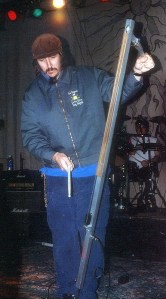
Yet again, during the first set whilst Primus were performing, Les Claypool was playing with his usual array of basses, but for ‘Mr Krinkle’ and ‘The Valley’ he uses a Ned Steinberger 5-String Electric Upright Bass.
Swapping between his vast collection basses would be the stagehands job to do it before the Que is given to the lighting engineers to light the stage back up again after the change is made, as seen in the video it’s been done fairly efficiently and done with no trip ups.
One of the last but most important role within the industry is security, within recent times it’s became apparent that security is an even more important role than ever within recent years due to such events as the Manchester bombing and because of this over the past year it has put the music industry on high alert. A number of promoters say that security expenses increased as much as 20 percent following Grande’s concert and that costs are rising another 10 to 15 percent in 2018.
Door Supervisors have specialist training to perform specialist functions. At live music venues these currently include all types of security, such as; front of stage pit teams, undercover anti-theft teams, undercover drug detection teams, drug detection dog units and personal searching specialist.
They staff some of the most critically important positions at concerts and sporting events and are there for the safety of everyone attending. Because crowd management and security is a top priority for events and venues, a large number of event staff members are needed to oversee this important task. These crowd management employees have received training in the field but are not formal law enforcement officers. Simply put, they keep things in order and respond when an incident gets out of hand or needs mediation.
But, without all of these roles we wouldn’t be able to produce quality live music for the public and it just goes to show how vital each and every aspect truly is!
If I had to do any of the following roles, I think I would choose to be a Sound technician and or a stage hand/manager, there any many different types of sound engineers also which all play a vital role with the delivery of live music.
But out of all of them I’d like to be a live sound technician because I’ll be able to ensure the quality of the sound and make sure it’s to a good quality that the audience have paid for.
On average a live sound engineer gets paid around about £25,000 to £40,000 a year which is a reasonable amount of money to do something I’m passionate within, the hours you’d work would be varied constantly which may become a pain at times if you want a social life within the evenings, but it would heavily rewarding most of the times because I’d be helping to produce a bands image and or vision, especially when it comes to Primus.
I’ll definitely need a good knowledge of music and sound technology, and I may find it useful to also have an understanding of physics and electronics.
I’ll definitely need a good knowledge of music and sound technology, and I may find it useful to also have an understanding of physics and electronics.
Having a degree with any of the following will help me to achieve this job,
a course in technical theatre, music technology or sound engineering
a degree or diploma in technical theatre accredited by Drama UK.
It would be useful also if I have paid or unpaid work experience, like:
Helping backstage in a theatre
Being a roadie for a band
Rigging sound in amateur or student theatre, or for local bands
Recording or mixing music, for example as a DJ
Working for a sound equipment manufacturer or hire company
I’ll definitely need these attributes:
Good hearing, for judging sound quality
A good sense of pitch, timing and rhythm
Patience, stamina and good concentration
The ability to cope with long hours and tight deadlines
I’ll also have to mix the inputs from microphones and amplifiers, using a control desk to balance the sound levels. You might also provide background music and sound effects.
My duties might also include:
Discussing the production’s sound needs with the director or sound designer
Identifying places in the script where any sound effects, music and changes in sound level are needed
Pre-recording any sound effects and music
Positioning and rigging up microphones
Completing sound checks before a performance
Operating the sound desk during shows Following a sound plan (known as a ‘plot’) and cues from the deputy stage manager
Looking after and repairing equipment
Unloading, setting up, dismantling and loading equipment at each venue when on tour
I may also have to set up and operate lighting equipment as part of a sound and lighting crew.
Whilst doing some research I found out that the salaries for live sound engineers are the following within our country.
Starter: £25,000
Experienced: £30,000
Highly Experienced: £40,000 (sound designer)
Freelance rates would vary from this research. You could always negotiate fees based on the type of production and your own track record. The Broadcasting, Entertainment, Cinematography and Theatre Union (BECTU) list suggested rates.
Working hours, patterns and environment.
Hours can be long and irregular.
Evening and weekend work is common.
You may also work during the day for rehearsals, sound checks and maintenance.
You’ll work in theatres, concert halls, arenas, and outdoors at concerts and festivals.
You’ll spend a lot of time sitting at a control desk.
You’ll travel throughout the UK and possibly overseas.
With the following experience, I could always progress to chief sound engineer in a theatre, become a sound designer, or set up my own sound services company which would be quality but it is up to me what my future can hold!
The label it was released under is called Prawn Song Record.
It followed two other live releases by the band, and it is the first release of the Frog Brigade’s original compositions, while the brigade regulars are consistent on the majority of the record such as Jay Lane, Eenor, Skerik and the new percussionist Mike “Tree Frog” Dillon many special guests appear on the album as well!
The Album totals within 56 minutes in length and its genre is Experimental Rock.
My favourite track on the album would have to be either ‘Whamola’ and or ‘Ding Dong’.
‘Whamola‘ was a live show staple and the song was eventually named after the unique instrument that Les employs- it’s a one stringed bass played with a drum stick, which enables him to achieve some pretty cool sounds with just one string.
It features a single string which is manipulated via a pulley-and-lever system, the pulley mechanism is mounted in place of the tuning pegs at the top of a double-bass-style neck, which is attached to a wooden or metal body featuring a bridge, pickup and stand. The Whamola is played by hitting the string with a drum stick and either fretting it against the neck with the other hand or using the lever to alter its tension and change the pitch.
The song then later appeared as the theme for South Park’s Season 10 and on wards, it was remixed with the other song primus made for them also which keeps the authenticity for older fans!
Purple Onion was released on vinyl for the first time on the 24th of November, 2009.
I like this album because it allows Les Claypool to unleash his and vent his madness fluently and it goes without saying that it definitely to pleased his hardcore fans to this very day. His work isn’t as near edgy enough or the same level of his works with Primus but it’s like a well needed breath of fresh air!
I don’t know if I’ll keep up with a weekly pace but I’m going to try post a new album I find every week!
This week it will have to be one of my favourite Primus albums that I’ve indulged myself within the past couple of months.
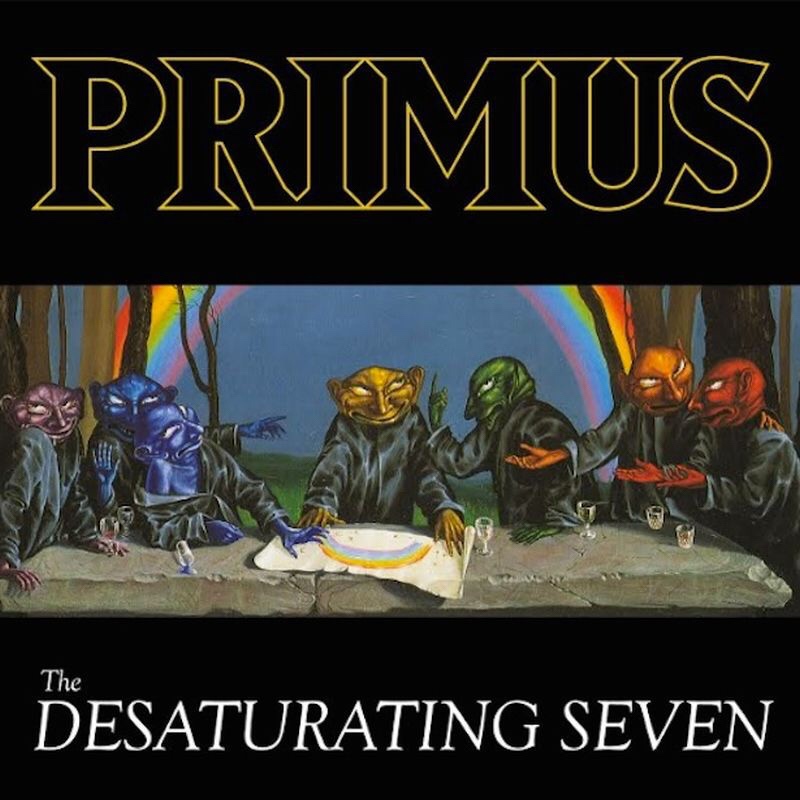
The Desaturating Seven – Primus
It was released on the 29th of September 2017, making the album just more than a year old today.
The labels it was released under are, ATO Records and Prawn Song Records.
It’s the ninth studio album by the American group Primus, it is also the bands first album of original material since their album released within 2011 called Green Naugahyde. And it is also the first LP featuring with the original drummer Tim Alexander since 1995 when they released Tales from the Punchbowl.
The Desaturating Seven is a concept album based on the children’s book The Rainbow Goblins, written by Italian author of children’s books, Ul de Rico. This is also explicitly shown within the colourful album cover which is personally one of my favourites!
The album has been noted as a stylistic change for Primus especially within comparison to their previous works. The album explores more or less the traditional aspects of progressive rock, it’s more or less tailored for fans of Primus in general or those into prog rock with a fun twist, because of the fun childish story to follow throughout the album takes play.
The constant use of panning throughout the majority of the tracks helps to create the surreal feeling Primus were always aiming for. Layering also helps this too because without a doubt something is always happening during a pause and or a build up to something big within the story they’re telling about the The Desaturating Seven!
The band consists of a standard prog rock line up in which being Bass, Guitar, Drums, keys and a hell of a lot of effects such as delay and distortion where it best seeks fit on the tracks.
The track, ‘The Seven’ definitely sets the fun mood for the whole album as it’s more or less an introduction to the seven Goblins that are presented to us on the album cover.
But overall, I think it’s one of Primus’ most creative albums along with ‘Sailing the Seas of Cheese’ and ‘Fizzle Fry’, but if you have the time I high recommending to this album for the sheer creativity of it!



 Ellie Thornton Music