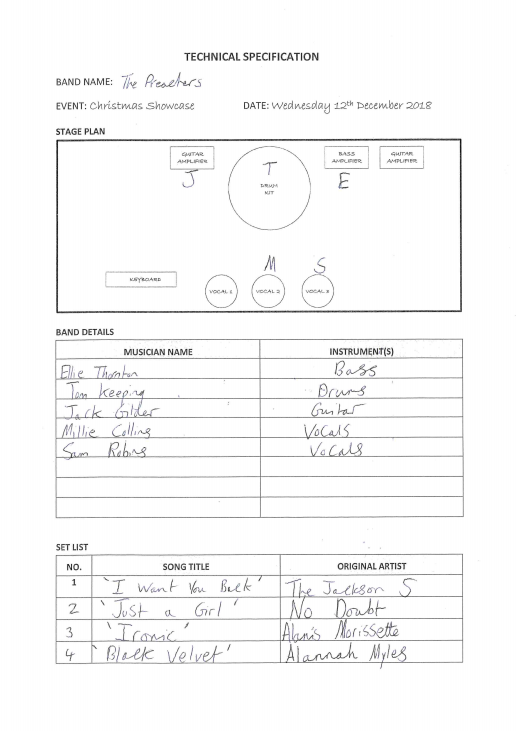
Today we went over one of the new songs for our set list for the December venue we are playing. Chris told us to choose at least 4 songs off of any of the 100 Now albums to form a 20 minute set, so far its been hard to figure out what we want to play as band with a male and female vocalist.
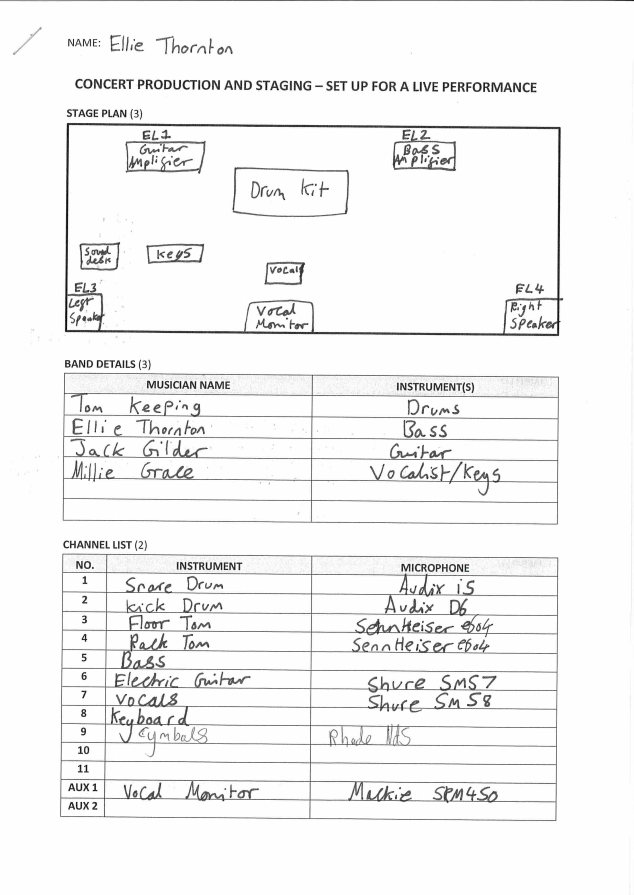
Within the music industry there are many aspects and roles that contribute to it behind the scenes to the public eye. One of the aspects of the industry is the live production of music, there are many people involved in the organisation and also the delivery of live music happening each and everyday roles like the following.
Security
Box Office
Hospitality
Stage Manager / Stage crew
Camera crew
Support act / slot
Lighting Engineers
Musicians – backing singers and session musicians
Hair and Makeup
Medical crew
Sound Engineers
I’ll be sure to go into much more detail later, and I thought I could possibly relate it to a Primus concert to keep me more engaged then I usually am!
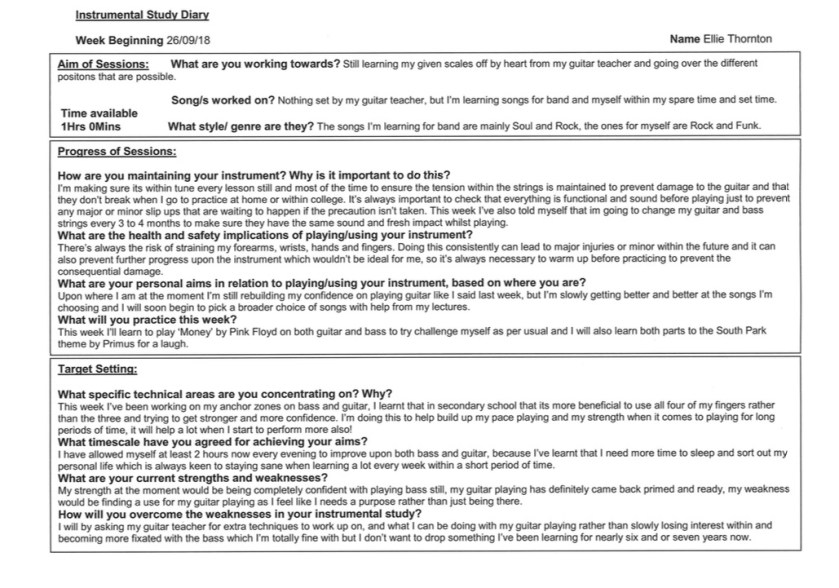
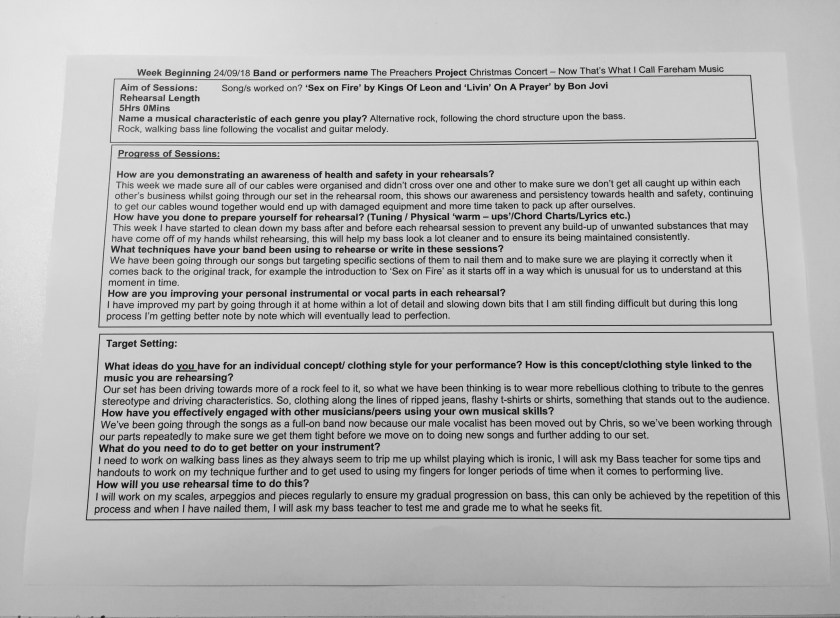
However, within Rehearsal today, our guitarist has chosen the song he wants to do which is called ‘Sex On Fire’, the song is fairly complex for an indie rock piece. Personally the bass line isn’t as hard as ‘I Want You Back’, but its always nice to take a break and have something light to play because I don’t want to strain my wrists and fingers whilst playing but i would of personally liked something a bit more challenging.
At the end of the day, during Rehearsal I was beginning to lose my patience with the band as we couldn’t come up and agree with a new song, so in the end I decided to summon Chris to help us choose something new and challenging, we all agreed upon playing Bon Jovi’s ‘Livin On a Prayer’ and because it was late we also said to go home and learn it in the evening, which I knew I was more than capable of doing as I’m a fast learner, especially when it comes to bass!
Nothing too exciting happened today, so in rehearsal we played through the song we have already a few times then proceeded to wait for our instrumental lessons, purely because we were still overwhelmed from our performance yesterday which went very well considering I was hoping someone would turn up but they got stuck at work which dug at me but I completely understood and went and performed to the best of my ability pretending that he was there.
Whilst waiting for my instrumental lesson, I talked to some of the second year students, they seem alright and a good laugh, I tend to be shy and intimidated by new people but it was all fine surprisingly
In my Guitar lesson we went over a few scales such as the Major Pentatonic and the Blues scale, in the different positions and establishing what goes where and what notes to play them from, etc. That’s always fun because scales are the gateway to improvisation and creating new melodies for songs!
Also, within the afternoon I had Music Theory with Chris, we went over common time signatures which is always refreshing after being neck deep within Grade 3 theory but it’s helpful for the rest of the class for some basic theory knowledge so I get why Chris needs to go over everything in detail. Whilst he does this I work on my theory and take occasional notes on things that are said that I may have forgotten previously.
Chris taught us was about Timbre, it describes the instruments being played and the sounds that they make.
The first song of the session is called ‘Lucky Man’ by The Verve.
Time Signature – 4/4
Tempo – 76bpm (Andante)
Timbre
Style – Brit Pop/Rock
Instrumentation – Electric and Acoustic Guitars, Bass, Male Vocalist (panned with delay/reverb), Synth/Keys, Drums, Strings (Violin/Cellos), Sound effecs and an E-Bow with Reverb.
Structure
Pitch
Dynamics
Next up is Neil Young with a song called ‘Old Man’.
Time Signature – 4/4
Tempo – 141bpm (Vivace)
Timbre
Style – Classic Rock
Instrumentation – Acoustic Guitar (Percussive playing style) , Male Vocals, Audience Clapping.
Structure
Pitch
Dynamics
And finally it would have to be The Beach boys with ‘Wouldn’t It Be Nice’.
Time Signature – 4/4
Tempo – 118bpm (Allegro)
Timbre
Style – Rock/Pop
Instrumentation – Detuned Acoustic Guitar, Brass, Drums, Bass, Male Vocal Line and Harmonies.
Today is the final day in rehearsal that we could go over ‘I want you back’, it went very well whilst practising today we have all nailed our parts and our connection as a band is very visually explicit for the audience to see which is always great to have when delivering live music to and audience even when you’re not being paid as its all for the experience in my eyes.
After that, in our composition slot we went over how this evening is going to play out because our gig is taking place tonight so we were excused as it was many peoples first time playing to an audience, but it will be composition fun times always on a Tuesday after today which I am looking forward too. I still struggle a bit with composing, it was my weakness in secondary as I always had to ask Ben for help during lessons but I’m sure I will get the hang of it and become more independent as time goes on.
When composition was over and everyone had a break it was theory time with Jason, I began to type up my notes from the previous session, but before that Jason showed us all how to fill a rehearsal diary to a high standard which he checked through before we left to go to lunch which was very considerate of him!
After lunch we rehearsed one final time before the gig which was nerve racking but i played it cool and relaxed rather than setting myself up for failure which I used to do but I have a feeling that it can only go well for us! We then had tutor with Chris which was a pep talk which was great then after wards we waited for the concert to begin.
We’ve been assigned to form a set list which consists of songs from the NOW album compilations, we also have to study the production methods and the genre then play these chosen songs at the end of the year for our Christmas Concert.
The albums were originally put together by Virgin Records and they were put together to showcase the hit singles of the year all in one album from that record label. When this concept brought in a lot more attention than previously expected, so then Virgin had to pick from many other record labels. During the course of the 100 albums that they’ve produced until now, amongst many other compilations on the side, every album is unique each and every year because without the musical elements and characteristics changed vastly within comparison to the first album produced.
Within our band at the moment the four songs that we are going through are the following.
‘I Want You Back’ by The Jackson 5, the genre of the piece is Soul and it was released in 1969,
‘Sex On Fire’ by Kings of Leon, the genre of this piece is Alternative Rock and it was released in 2008,
‘Mercy’ by Duffy, the genre of the piece is Pop Soul and it was released within 2008 and finally,
‘Treasure’ by Bruno Mars, the genre of the piece is Disco, and it was released within 2013.
Within any form of creative act and or production such as music, theatre, art and literature; it all has its own form or personality, a genre.
Soul – ‘I Want You Back’ by The Jackson 5
Vocals – emotional vocal story and or journey
Emphasis – consistently passionate and always uplifting to listen too.
Within soul music the electric and or acoustic guitar is usually played percussively, emphasizing the second and fourth beat of each bar. The strings are muted by the hand to show more of an attack in the sound producing a staccato sound, although palm muting as a technique is more often found in rock. In our guitar, bass and drum arrangement the guitar had to operate a lot busier to decorate my walking bass line and too fill out the sound around the melody.
Walking bass lines were also introduced to keep the groove between the bassist and drummer tight which helps to lock in with the audience by encouraging them to dance, it is the syncopation In the dotted rhythms played by the bass which provide the movement in the arrangement that persuades the listener that it may involve their physical response as well as an emotional one.
Soul songs were most typically played within a straight 4/4. In this particular arrangement the fourth beat is heavily accented to provide a more original take on emphasized beats within the genre it’s being played in.
Tempo – not all soul songs have to have a very fast tempo (presto and or allegro) or very slow (largo and or andante), the differentiation usually comes between Soul produced in the North of America (Detroit – Motown) and the South (Memphis – Stax and Atlantic).
Rhythm is also heavily strengthened by percussion such as tambourines, triangles, etc.
Some soul songs and bands may have also consisted with a Horn Section with brass instruments such as Trumpets, Saxophones, and Trombones.
String section, violins, cellos.
But the instrumentation in soul consisted with the following,
Vocals and backing harmony vocals (male and female, usually three part)
Electric Guitar
Piano / Electric Piano
Electric Organ / Keyboards
Bass
Percussion
Drum Kit
The Performance and Arrangement also consisted of the following also,
Large ensembles with a lot of the instrumentation being doubled up
Emotional vocal delivery. This ranged from forceful and high energy to sad, reflective and passionate. This vocal delivery could often be gritty in tone, with added hollers, screams and vocal improvisation.
Driving rhythm with drums and percussion giving a steady backbeat on beats 2 and 4 and regular percussive tom fills leading into choruses.
Rhythmical, melodic walking bass lines
Rhythmic chordal parts on piano and guitar
Typically, a brisk tempo around 120 bpm or faster, dance music
some slower tempo ballads (Southern soul – Gospel inspired)
Strong use of vocal and instrumental hooks
Use of call and response
Short songs with simple structures such as verse/chorus form, sometimes with a bridge and instrumental sections
Melodies often using a pentatonic scale with additional blues notes.
It combines elements of African-American gospel music, rhythm and blues and jazz. Soul music became popular for dancing and listening in the United States, where record labels such as Motown, Atlantic and Stax were influential during the Civil Rights Movement in bringing attention to a sophisticated black art form. Soul also became popular around the world, taking influences of rock music and the music of Africa.
Motown soul music typically used Pianos as they had more of a jazz influence within Detroit and its jazz scene, and very often Jazz musicians would be recording for Motown during the day and playing jazz at night.
Motown played an important role in the racial integration of popular music as an African American-owned record label that achieved significant crossover success. In the 1960s, Motown and its subsidiary labels (including Tamla Motown, the brand used outside the US) were the most successful proponents of what came to be known as the Motown Sound, a style of soul music with a distinct pop influence. During the 1960s, Motown achieved spectacular success for a small record company: 79 records in the Top Ten of the Billboard Hot 100 record chart between 1960 and 1969.
Motown was and remains the company’s main label for mainstream R&B/soul music (and, today, hip-hop music as well). Notable Motown artists have included Mary Wells, the Supremes, Four Tops, Michael Jackson, the Jackson 5, Boyz II Men, Commodores, Lionel Richie, Dazz Band, Brian McKnight, 98 Degrees, and Erykah Badu.
Motown Records slogan was: “The Sound of Young America”.
Many of the songs in this style were performed by vocalists backed by the house band of Motown, known as the funk brothers. The Memphis soul sound was different from the Motown sound from Detroit as it was influenced by the Gospel music of the Black American Church.
The Stax Museum of American Soul Music is dedicated to preserving the facts behind The Memphis sound.
Within Stax recordings, the musicians would use Organs instead to counterpart the Pianos already being used and because of the heavily religious background of many of the performers, the organs were used to try and recreate the sound of the Church in ballads. Memphis Soul’s shimmering, sultry style produced in the 1960s and 1970s at Stax Recordsand Hi Records in Memphis, Tennessee, featured things such as melodic unison horn lines, organ, guitar, bass, and a driving beat on the drums.
Atlantic records also traded on its soul catalog
Over its first 20 years of operation, Atlantic Records earned a reputation as one of the most important American recording labels, specializing in Jazz, R&B and soul recordings by African-American musicians including Aretha Franklin, Ray Charles, Wilson Pickett, Sam and Dave, Ruth Brown and Otis Redding.
Its position was improved by its distribution deal with Stax Records.
And then within 1967, Atlantic Records became a owned subsidiary of Warner Bros-Seven Arts, now known as the Warner Music Group, and expanded into rock and pop music with releases by bands such as Led Zeppelin and Yes.
Black performers are traditionally more associated with deep and meaningful soul, gospel, etc. Although this went on to influence white rock performers like The Beatles and The Rolling Stones who made soul popular for white audiences. Both of these groups took black soul music back to America at a time where black performances were ignored due to segregation.
During the early 1960s the majority of black people were fighting for the Civil Rights Movement. Within this time period white and black people were segregated within everything. Soul was eventually celebrated together by black and white mixed audiences when civil rights were finally granted, and then everyone of all races came together to celebrate Soul Music and other variants of black music!
Recording Processes and Production within Soul.
1950s – there were only two “recording tracks”, one for the vocals and or vocalist and then the other one for the entirety of the band.
1960s – ten years later or so there were now four available tracks to record upon you could also use the tape it’s being recorded upon to do methods such as overdubbing to make the vocalists sound a lot sound a lot stronger when needed and to incorporate many more instruments than a traditional rock band on the recordings.
The tape could be wiped over and over again until the band were happy with their take, it had to highlight the best of their abilities combined to be considered a final take it may also have been edited to join the best bits of multiple takes together to form the perfect performance, albeit faked through studio technique.
Technology and Production then went on to progress further years to give us all of these advancements.
Early adoption of multi-track tape machines, 4-track then an 8-track
Live recording of a complete band in a single room with acoustic screens to provide separation
Use of DI guitars and basses
Close mic recording of drums
Vocal overdubbing
Use of echo chambers
Plate reverb such as EMT 140
Use of classic compressors such as Teletronix LA2A, mixed fairly gently into the recording
High-quality recordings with clear vocals
Stereo mixes with extreme panning this is unconventional by today’s standards, like all drums and bass on the left all vocals and other instruments on the right
According to the Rock and Roll Hall of Fame, Soul is “music that arose out of the black experience in America through the transmutation of gospel and rhythm & blues into a form of funky, secular testifying“.
Catchy rhythms, stressed by percussive handclaps and extemporaneous body moves, are an important feature of soul music.
Other characteristics, such as a call and response between the lead vocalist and the chorus and an especially tense vocal sound.
Soul music reflected the African-American identity and it stressed the importance of an African-American culture. The new-found African-American consciousness led to new styles of music, which boasted pride in being black.
A lot of soul music rose to prominence through independent record labels distributing the product and this is how indie music has risen to the mainstream since the late 70s.
Alternative Indie Rock – ‘Sex On Fire’ by Kings of Leon
Ironically, most early alternative rockers were born between the late 1950s and late 60s and then grew up during the 70s amid the head-spinning studio refinement and the growing social acceptance of the earliest rock music.
Alternative rockers looked for inspiration to an earlier generation of cranky stylists in the United States and Britain. Of 1970s musicians, they revered the rough aggressiveness and obsessional DIY of The Buzz Cocks, The Sex Pistols and The Clash, and then the arty formal daring of many other American Punk bands such as The Velvet Underground, The Stooges, and Patti Smith.
Among 1980s musicians, alternative musicians sensed kinship with American upstarts like The Replacements and Hüsker Dü, bands that had operated out of their own garages and later on as part of an ever-expanding network of labels and clubs that shared their commitment to independence.
Both Generations of alternative role models enjoyed very little if any Pop success. The only exception to this was R.E.M., they were viewed to have bridged the admirable values of both decades and slowly built broad-based success on the band’s own special terms.
By the late 1980’s, however the music scenes in Seattle, Los Angeles and Chicago gave rise to younger alternative musicians who wanted to balance maintaining stylistic independence with reaching larger audiences.
Moreover, The Record Industry is always looking for something new and loud, they therefore began to invest in such goals, thus boosting production values.
In Hollywood, Jane’s Addiction signed with Warner Brothers Records and they then produced “Nothing’s Shocking” (1988), an album on which offered odd guitar tones disrupting meters clearly and forcefully as had been done upon any Classic Rock recording.
Just as the 1990’s dawned, The Smashing Pumpkins began their ultimately very successful quest to make what their bassist, D’Arcy called “beautiful music that varies”, out of many-hued guitar tones that cracked and frazzled.
Then in 1991, Nirvana and producer Butch Vig releases “Smells Like Teen Spirit”, from epochal 1991 album Nevermind.
The sheer immediacy of its expert guitar distortions (using big muff pedal technology) and layered orchestrations – which was influenced by the organized noise of British pop groups such as The Cure and My Bloody Valentine – assured that “grunge” as the music based on those feedback sounds was called, would soon then become a world wide pop phenomenon.
What alternative rockers hadn’t counted on was that, by the time Nirvana had released Nevermind, the young rock audience had gotten tired of the same sounds the musicians had rejected.
A few exhilaratingly growled notes from Nirvana, and suddenly the previous decade of slick, well thought out digitally metallized “hair rock”, in which being the sound of such million selling bands as Warrant and Poison; they all seemed as hopelessly Passé as the extremely tight spandex pants worn by such bands as themselves.
But no matter how loudly some alternative rockers professed to despite the classic rock that preceded them, bands such as Soundgarden and Screaming Trees did in fact echo their childhood memories of The Beatles and Led Zeppelin.
Alternative musicians had definitely intended to make music for themselves; and in the end, the movement created the sound of a very resentful and distressed generation that has lived on until this very day.
The standard line up for a rock band would be an electric guitar, electric bass, drums, vocals, keys and a rhythm guitar to pack up the lead, however in alternative rock although two guitars are used both intertwining single line melodies to fill out the arrangement between the vocals.
Vocal styling within alternative rock could be said to embrace tones and pitching unlike the masculine posturing of rock. Alternative voices like, John Lydon, Shaun Ryder, Robert Smith and Edwyn Collins celebrated their uniqueness and brought something other than mainstream pop and rock could offer filling the gap that an alternative rock audience craved.
Within ‘Sex on Fire’ the main aspects of the arrangement and production would be the vocals, guitar and drums. This is because without it the song would sound minimal and bare.
The guitars tend to be heavily and or fairly distorted much like rock but they very often have no distinction between the rhythm and lead guitar work, which accompany the harsh gritty sounding vocals, which also come from rock but are here deployed in a very catchy way which is nearer to pop than it is rock, so this blending of tones borrowed from more mainstream genres is seen as an alternative measure. Although riffs can be detected within alternative rock they tend to have discordant elements within them that can catch the ear as much as any melodic riff. This is very much the case within ‘Sex On Fire’ by Kings of Leon.
The guitar riff should start on the 4 of the bar beforehand of which it starts, but some drummers may find this difficult so you can add the extra count to the end of the riff to make it easier for the drummer to count. There’s meant to be 17 counts before the drums kick in along with rest of the band, that’s why the arrangement is sometimes confusing for musicians to get their heads around. Many would say there is an offbeat feel to the rhythm track in this recording, which again proves to be the alternative in an overly rock centric production. Even the lyrics in an alternative rock song tend to be difficult to penetrate. This is a song explicitly about a relationship which is not uncommon to rock, but in the alternative sphere the aim is to make the meaning of the lyric more hidden and therefore that is why a lot of alternative rock performances tend to have muddied lyrics as if to build more mystery into the writing/performance.
Pop Soul – ‘Mercy’ by Duffy
Pop-Soul is soul music that has been polished slightly and given a commercially viable, crossover production. The vocals are still raw, but the material and the sound of the record could easily fit onto pop radio stations’ playlists. Motown was the pioneering label of pop-soul, and through much of the ’60s, it was one of the most popular pop music genres. In the ’70s, pop-soul became slicker, and it eventually metamorphosed into disco.
The style is exemplified by Motown Records artists such as The Supremes (‘Baby Love’), Martha and The Vandellas (‘Jimmy Mack’), and The Miracles (‘Tears of a Clown’).
The triads within the blues scale help the arrangement feel livelier rather than just having bass, drums and vocals.
The chord progression is built up off of the following numerals within the key, 1st, 4th and 5th, these are the building bricks of the 12 bar blues form which is at the heart of Duffy’s ‘Mercy’.
The song is built upon a 12-bar blues the chords that make this are G, C, D. Within the arrangement there are also catchy simple repetitive melodic phrases which gets the audience hooked and gets them to join in with the band, this is the pop element in the writing.
The use of a Farfisa organ in the recording relates back to soul as does the use of a dance beat. It’s interesting to study the music video for this recording as the dancers are doing steps in the video that come from northern soul. Northern soul is a genre built on forgotten recordings that came out of other small independent recording labels in and around Detroit in the north of America. This is one of the reasons why the music is known as Northern Soul, the other being that it was rediscovered by soul music fans in the North of England.
‘Mercy’ is set in common time, with a tempo of 130 beats per minute and is written in the key of G major. Soul/Pop songs are often written in a major key as the messages are full of hope. The speed of the tempo is designed to fuel a dance floor. Duffy’s vocal range spans from D4 to D6 which is quite limited for a soul singer, however her tone is expressive and gritty and these are two elements often found in soul performances past and present. There’s also an added blues note to the chord progression which gives it that black, blues soul sound.
The introduction to ‘Mercy’ is similar to the opening bars of ‘Stand by Me’ by Ben E. King. The sound is slightly different from that of ‘Stand by Me’, however, because ‘Mercy’ uses the 1st, 5th and flattened 7th degrees of the scale, instead of the 1st, 5th and major 7th. This change creates a bluesy sound and the plucked, pizzicato sound of the playing style in the opening reminds of ‘Stand by me’.
Duffy has noted that during recording with Steve Booker, ‘Mercy’ “was like this melodic poem in my mind, which I just had to get out, and I knew exactly what I wanted it to sound like”. She has also said that they “built the song from the bottom up”, also noting that it is “very important that my songs start from an organic source, rather than a drum loop”.
When asked of the lyrical meaning of the song, Duffy said: “The lyrics were about having a feeling towards someone, whether it’s a romantic feeling or just some chemistry that you don’t want, and you desperately want to be released from that feeling.” The use of the word ‘Mercy’ in the lyrics is also very soul like in the way that a lover is asking for forgiveness in a relationship.
Within the production side of ‘Mercy’, the feel it gives off is more or less a modern take on soul with a subtle nod back to its originator. It has been made clear that the track has been structured upon digital samples, almost as if it’s a backing track for the lead singer.
With our modern advancements upon technology, the artist was able to achieve a lot with a fairly minimalistic arrangement with gives it this comfortable texture. Throughout the song there are pro-dominant signs of synthetic strings which lay down a solid foundation for bass but unlike anything you’ve heard of before. There’s also a subtle addition upon the guitar which is used within the production to add tonal colour to the arrangement.
In the Stereo mix there are two key instruments, to the left there’s almost alienated bass sound which is played throughout the arrangement, this anchors the recording and alerts the ear to a sound that could be bass, but reinvented in the production for a modern audience.
To the right there’s a synthetically created Farfisa Organ sound which roots the production in the 1960s when they were popular, but considering that this is a modern take it will have seen the producers use a keyboard that could recreate this tone.
As previously mentioned the vocals on many ‘Pop Soul’ tracks are mannered with the singing style and tone often being more important than the words that are being sung. As this performance is inspired by soul thee rendering of the melody is in a very heartfelt and passionate style, with a lot of vocal improvisation.
Disco- ‘Treasure’ by Bruno Mars
Disco is a genre and subculture that emerged in the mid-1960s and early 1970s from America’s urban nightlife scene.
It started as a mixture of music from venues popular with African Americans, Hispanic and Latino Americans, Italian Americans, LGBT people (especially African-American and white gay men), and psychedelic hippies in Philadelphia and New York City during the late 1960s and early 1970s.
It can be seen as a reaction to both the dominance of rock music and the stigmatization of dance music by the counterculture during this period. Several dance styles were also developed during this time, including the Bump and the Hustle.
The disco sound is typified by four-on-the-floor beats, syncopated bass lines, and string sections, horns, electric piano, synthesizers, and electric rhythm guitars. Lead guitar features less frequently in disco than in rock.
Well-known disco artists include Donna Summer, the Bee Gees, Gloria Gaynor, KC and the Sunshine Band, the Village People, Thelma Houston, and Chic, and many at the height of the genre’s popularity, many non-disco artists recorded disco songs too.
While performers and singers garnered public attention, record producers were working behind the scenes played an important role in developing the genre. Films such as Saturday Night Fever (1977) and Thank God It’s Friday (1978) contributed to Disco’s mainstream popularity.
Disco was the last popular music movement driven by the baby boom generation. It began to decline in the United States during 1979-80, and by 1982 it had lost all popularity there. Disco Demolition Night, an anti-disco protest held in Chicago on July 12, 1979, remains the most well-known of several “backlash” incidents across the country that symbolized disco’s declining fortune.
Disco was a key influence in the development of electronic dance music and house music. It has had several revivals, such as Madonna’s highly successful 2005 album ‘Confessions on a Dance Floor’, and again in the 2010s, entering the Pop charts in the US and the UK.
‘Treasure’ was written by Bruno Mars, Philip Lawrence, Ari Levine and Phredley Brown. It is a disco, funk, soul and post-disco track and its heavily influenced by R&B.
Mars, Lawrence and Levine form The Smeezingtons; they produced the song under that name. According to the digital sheet music, the song was composed in common time and in the key of E♭ major with a tempo of 112 beats per minute.
The chord progression within the song consists of A♭m7–(Gm7)–Fm7–Gm7–Cm–(B♭) repeats throughout the song, changing only to end phrases on B♭9sus (A♭/B♭), a deceptive cadence. The instrumentation is made up from the guitar, piano, electronic keyboard, drums and bass.
To start off the production side of things we have the drums. From what I can hear the Hi-Hats have been recorded separately to the rest of the kit, this has been made clear by the way they’ve been panned in the stereo mix. Also, the production has made them sound awfully compressed; it also gives off a slightly ‘fizzy’ effect to the cymbals if it has been done this way.
It is also possible to do a production method called ‘Saturation’, this is done when you record with a very high gain onto tape. The distortion that takes place when recording this way adds this kind of surreal broken sound that can work surprisingly well if done correctly.
You cannot do it with digital recordings because of the way digital recording works VS. tape, a prime example of the old analogue VS. digital war! However, within the production they may have used a drum machine which would have made the recording process a lot easier, to be fair it is hard to tell.
The percussive hand claps blend in very well alongside the snare, within the mix it has been thrown into a retro way that exemplifies the snare wire. When it comes to close micing techniques; a top snare mic captures more warmth and skin noises, whilst the bottom snare listens more carefully to the snare wire which gives a strong crack and higher, brighter tones.
When it comes to production you can blend the two together for the sound off of this track, for example ‘Soul Meets Body’ by Death Cab has a snare that exemplifies the bottom, it isn’t Disco but it is another great example of what has been done in this production. But on the other hand so is ‘Disco Inferno’ by The Trammps which definitely demonstrates the sound they were aiming for in the production of ‘Treasure’.
Next up another method used is by the guitar, the method used is called pedal guitar has been used heavily on this track, it is fairly similar to the style used in ‘I Want You Back’ by the Jackson 5.
Another noticeable method being used by the bassist is called ‘Slapping and Popping, it is used to produce percussive sounds with the bass whilst hitting the strings against the fret-board. To achieve this sound in the prodution the musician has to strike the strings with the bony part of their thumb alongside popping notes by pulling a string until it snaps against the fret-board.
It is most often used within Disco and Funk, hence why it is used in this production. Some bass players are known for their use of slapping in their playing include Les Claypool, Doug Wimbish, Victor Wooten, Larry Graham and many more.
The sound of the keyboard being used is essentially replicating a 70’s Synth sound which is a nod back to the originators of Disco, the sound it produces can achieve many things such as soaring solos to sweeps, effects and vintage warmth.
Finally, when it comes to the production of the vocals there is a distinct vocal delay throughout the track amongst a handful of vocal harmonies and call and response which auto-tune has had a huge play around the direction the track went within.
It sounds as if the vocal tracks within the mix have been compressed which makes all the vocal harmonies sound like the lead vocalist, this has been achieved by using multiple tracks. When it comes to the video it looks like he is being backed up by the rest of the band, to a passive listener however to an active listener you can hear that it is just himself.
To conclude this piece, it is clear that when it comes to varying genres the production techniques and methods vary massively which help to produce a wide range of different sounds, textures and arrangements which broadens the horizon for new music within the future!
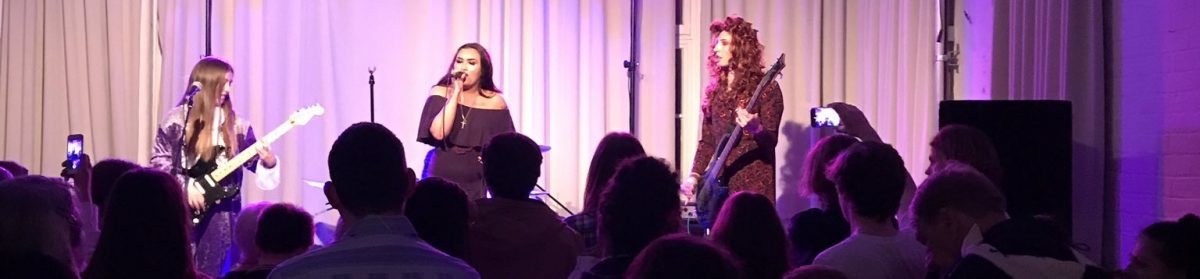
Here is a video of ‘Warm Up Christmas’ gig, it went particularly for each and every band, we will all definitely get better from this point onward!
After our first take at a ‘Warm Up Christmas’ gig we decided to come back after a week later, we have improved a lot when in comparison to the previous take.
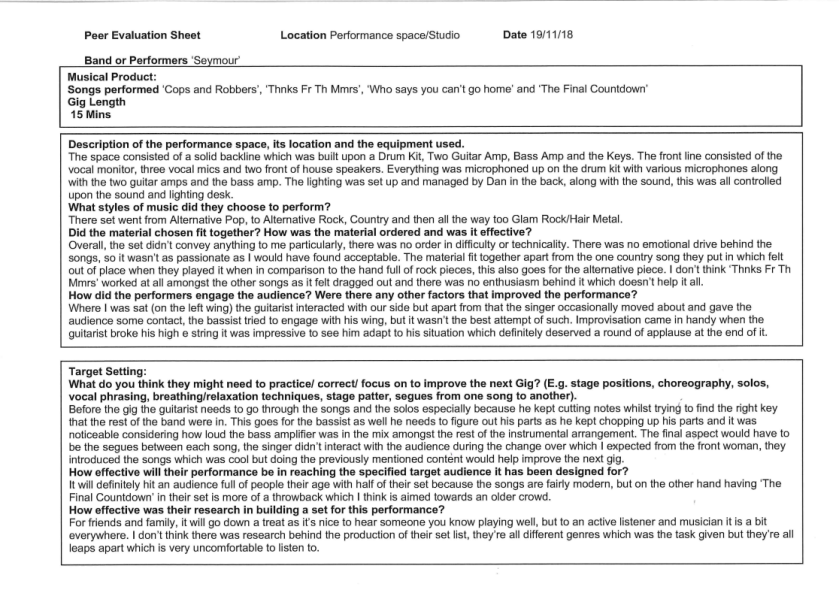
Yesterday evening went very well for all of the first year bands: level 2 and 3!
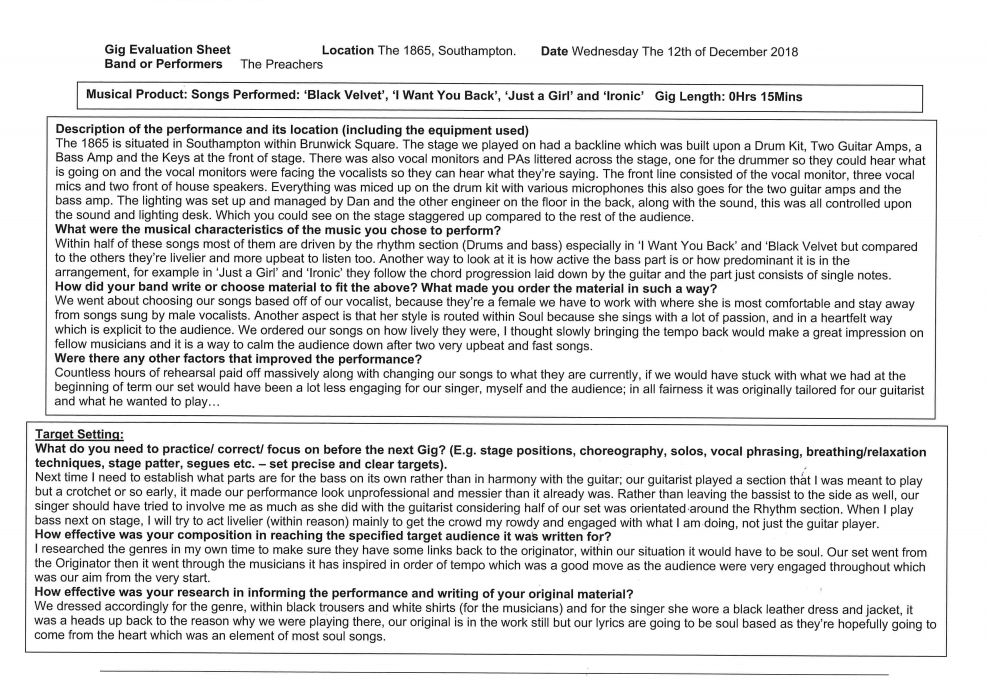
It started off with the Level 2 band then we began to go through each Level 3 band, my band being the last one before the break. Our performance was fairly explosive compared to the gradual build up before hand; as a band we were visually appealing to, we agreed to wear black and white to set the mood for the soul song we were playing and for its historical background too, for soul players at the time they were expected to dress smart to try impress the white audience, because typically most soul performers were black.
Playing wise, I could of done better and this goes to both me and the guitarist here, as we didn’t have time to warm up our hands. For me this could of brought up more strain than need within my hand from playing in the cold, next time depending on the temperature either way I will be warming up before and after.
The change within dynamics from forte the first time to piano on the second, was also a big help for impact, no one else thought of the effect it would have on the audience; I thought it made the song a lot more meaningful and it helped to show that it meant a lot to our band!
However, it was a very good first performance overall and I cannot wait to further improve as a professional musician and play more venues representing Fareham Music!
 Ellie Thornton Music