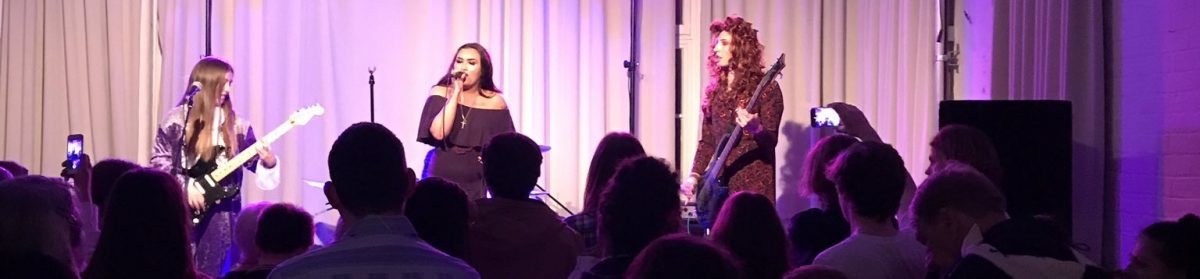
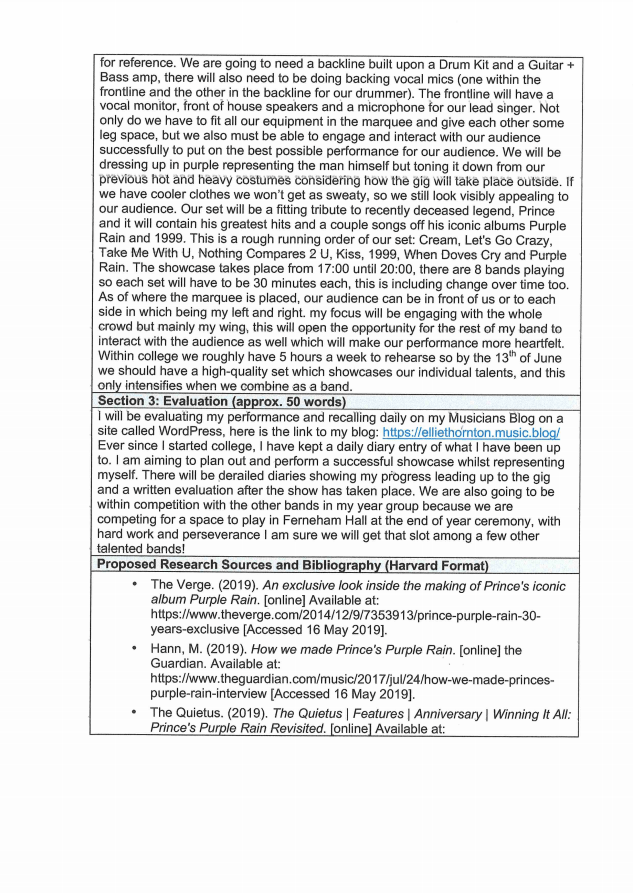
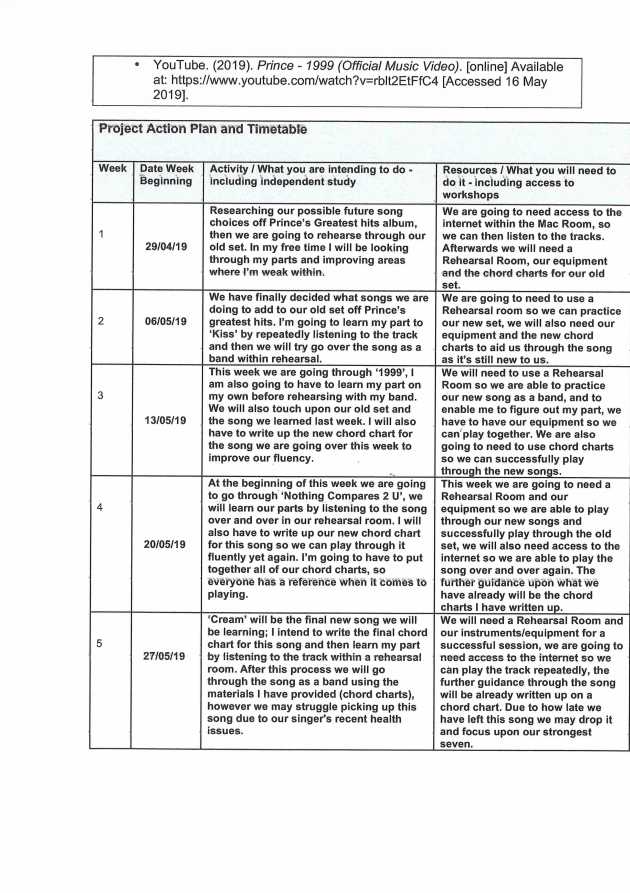
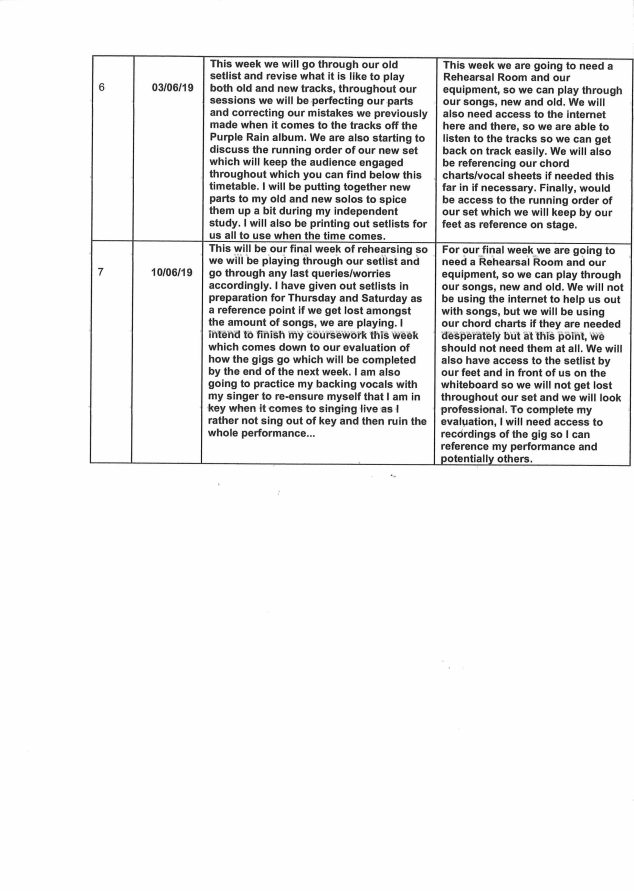
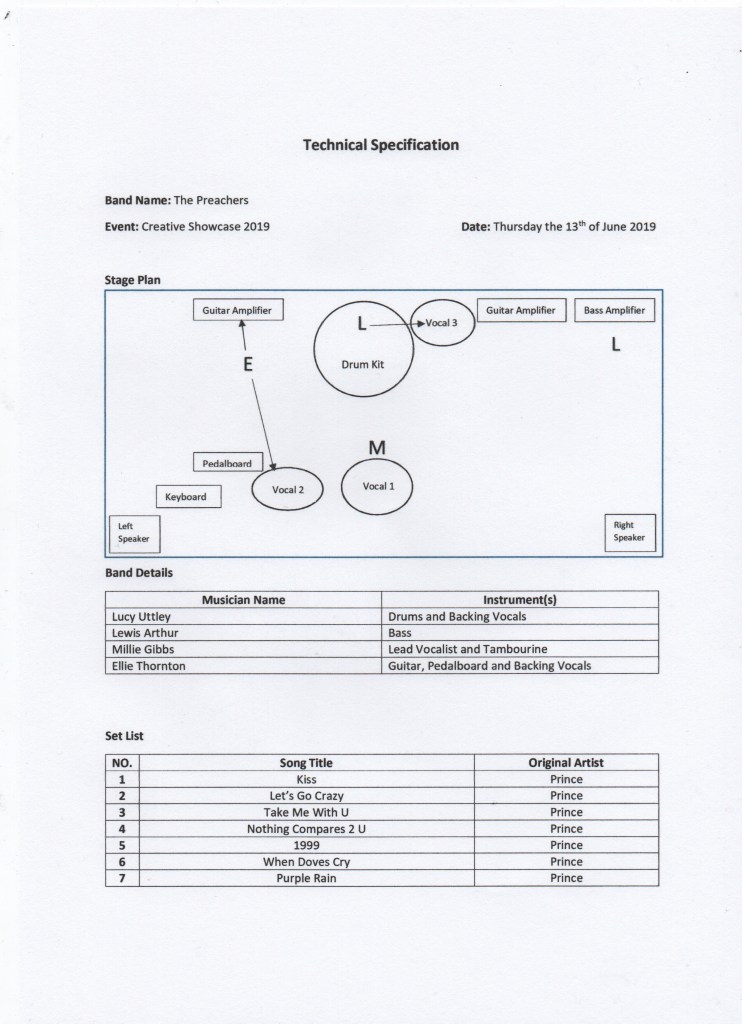
On Thursday the 13th of June, my band called The Preachers performed our half an hour tribute to the recently deceased legend Prince for Fareham College’s Creative Industries Showcase. This tribute was a fitting ad-on to our previous gig where we performed a tribute to his iconic album ‘Purple Rain’ at the Ashcroft Arts Centre.
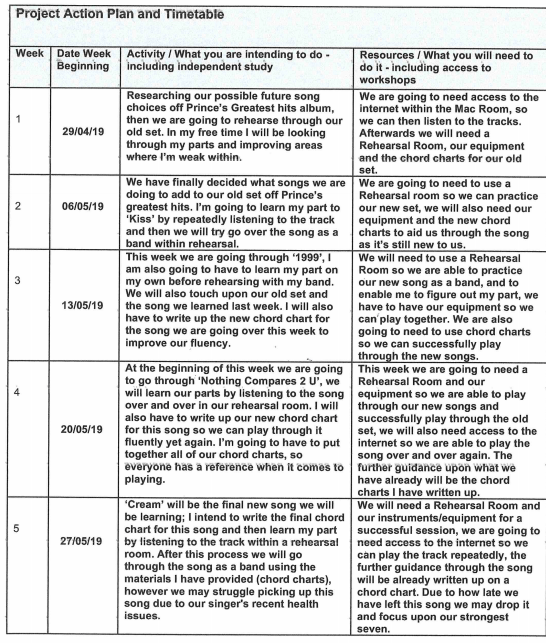
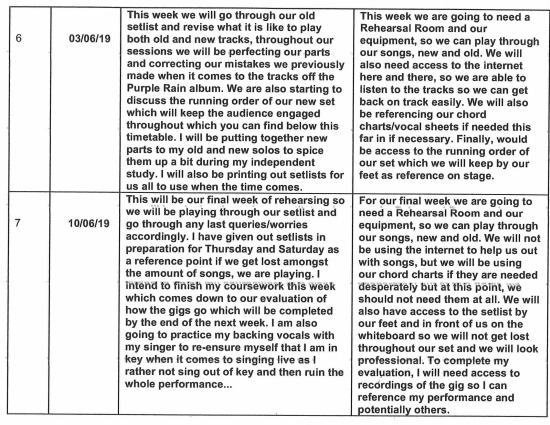
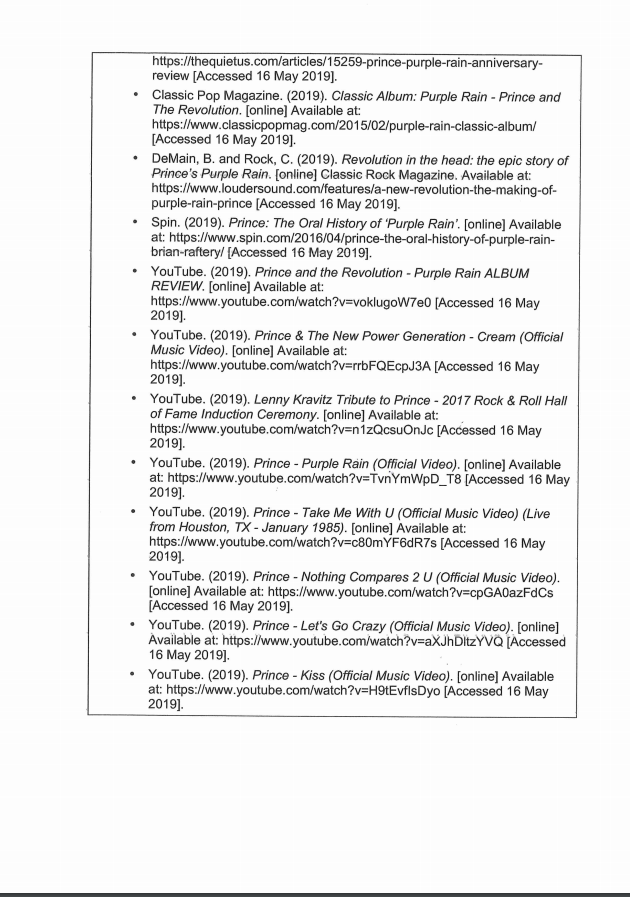
Our performance consisted of seven Prince songs, lasting for about 25 minutes. Our set list went like this. ‘Kiss’, ‘Let’s Go Crazy, ‘Take Me With U’, ‘Nothing Compares 2 U’, ‘1999’, ‘When Doves Cry’ and ‘Purple Rain’. We have chosen ‘Purple Rain’ to finish yet again like we did at our last gig, as it’s Prince’s most popular song and would therefore leave the audience on a high note after they leave from our performance.
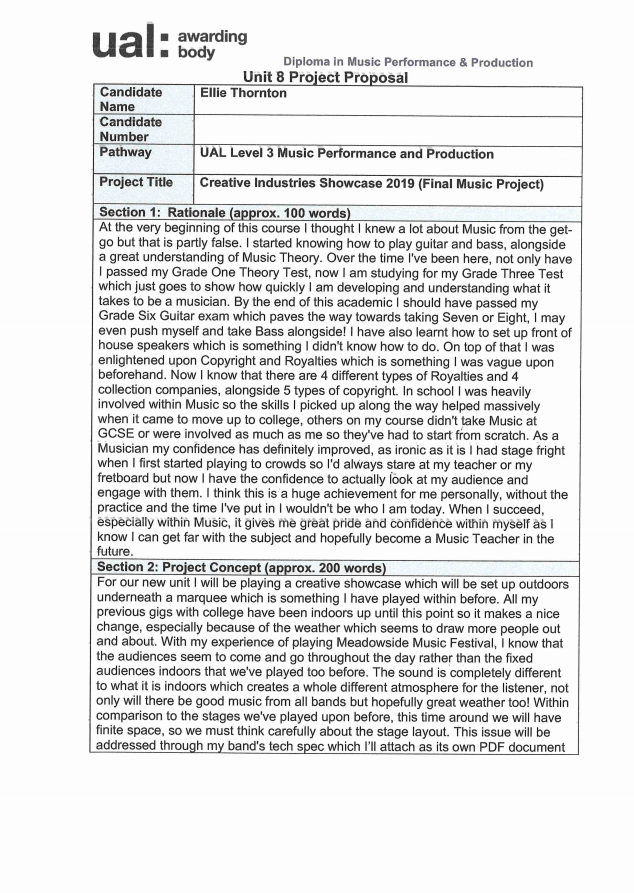
The idea behind the Creative Industries Showcase is to showcase the abilities within all creative departments in our college, this is built upon Music, Fashion, Art, Media, Food and Beauty. The music department had a marquee put up outside in hopes for the weather to be better than it was, but this week there wasn’t much good weather about.
It rained throughout the showcase, however it started to clear up during my band’s performance. We managed to sustain a decent crowd for the most part even though it was wet and cold…
The cold and wet weather did destroy everyone’s mood in comparison to our gig indoors last time, but everything comes at a huge cost. We managed to keep our spirits up as we went on stage whilst the rain poured down upon us and saw that we still had somewhat of an audience, despite the band before us overrunning massively.
We went through our set list smoothly and I came off-stage somewhat more confident than I came on, we had put on a good performance but there’s a lot of areas where we could improve within especially if we wish to play outdoors more in the future.
Kiss
We have worked upon this song for about three weeks, possibly two but we have brought it up to a high standard but there are always areas to improve within. On the structure side of things, we had that nailed, this is because I had handwritten chord charts which go through the roots, I am playing which synch up to the vocals which is a key feature in most of Prince’s songs.
Musically, our rhythm section was tight enough to enable me to noodle around over the top of them where it seemed fit, but for the most part I reinforced the notes the bassist was playing so our singers vocal melody came across as strong and full of impact.
When the time came there is a spot in the original for the solo, just like all of the other songs I have not improvised over the top of them. I have taken the time to sit down and learn the solos, because we are a tribute to Prince so on my part, I try to make it as authentic as possible. This is by far one of his easiest solos as it consists of three chords over and over, which smoothly leads in to a bit of noodling.
I am always careful during the transition, if I am either to late or too early it ruins the flow of the rest of the song which doesn’t sound particularly good. The song then ended on a high with the fade out being the final word spoken drawn to a short but sharp close which keeps our audience hooked for more!
Let’s Go Crazy
This is the most difficult song for me to play through, mainly due to the fast-paced solo which come multiple insane bends over and over. For the entirety of the set I had trouble reaching my microphone so it was hard to sing my backing parts, luckily the drummer had it covered for this song, reaching over to it seemed to be the best alternative, so I yelled them from a distance instead.
Yet again our rhythm section was tight, I had my leg room that add what I wanted and to drop out in parts where the track needed it but that was not necessary. When It came to the solo, I was okay for the most part, but when it came to the fast return into the chorus my hand seized up and it sounded a bit sloppy.
However, we brought it back at the end together as a band with our amazing ending which brings the song back dramatically in tempo and catches the audience’s attention because it is very loud and flashy at the same time. It is a perfect ending to the fast-paced section which brings into the more laid-back area of our set.
Take Me With U
The start of this song was originally played on a synth, but due to our band not having a keys player I am the only one who was able to play this part to start us off. The drum fill that goes along with it draws the crowd in, when anyone hears an instrument which is meant to keep a strong back beat do something obscure it is an ear pleaser.
This melody starts on the second beat, there are some occasions where if I am feeling weird, I will play it as if it is ¾ or that it starts on the first beat. Which is stupid of me I admit but I have learned from my mistakes within rehearsal and have begun to perfect this song being one of the original four!
Within this song, most of it we were very tight as a band and you could hear that we were all locked in with each other from the beginning. This in which slowly began to change over time which then led to the changeover in another verse which was to an F. Me and the bassist messed up during that particular change and it was hard to tell who did it, but we quickly picked ourselves back up from that unrecognisable mistake and finished the song successfully.
Nothing Compares 2 U
Working this song at a band didn’t take long due to the arrangement being quite sparse, most of the song was filled out in the mid-section by a saxophone solo which I opted out of playing over. Now that I look back on it, I could have put something within that gap but after spending weeks on end listening to the track I didn’t work out in my favour.
Within rehearsal we played around with dynamics heavily within this track, and this paid off life, as I will go on to mention. We focussed yet again on the vocal melody, for an example when death was mentioned we got quieter until the point we were turned off until we came back very suddenly with great force which dragged our audience in, only for us to then push them away.
We played through this song until the end with no slip ups throughout which is another personal achievement for us as a band and individuals. However, the only thing I would change is me on guitar, the keys would have filled the arrangement more and instead of Prince’s version we could cover Sinead O’Connor’s cover which is more well known.
1999
This was the most challenging of all songs to figure out and bring up to our performance standard. Considering we don’t have a keys player it was hard for me to fill out the emptiness without keys in this track, like all of our other songs. For a week or so in rehearsal I chose to play the progression in Minor just like the original track. After a week of playing it in minor I soon realised it sounded a lot better Major instead.
To it give it that extra something I threw in some wah to broaden the Choruses and the outro, the rhythm section kept together well throughout. They both gave each other space to show off whilst maintaining what they needed to play which is impressive and goes to show what a year of playing together can achieve.
Yet again, instead of me on guitar it would have sounded a lot better with me playing the keys but that is an area I would need to improve on heavily to bring it up to my performance standard, but that is something to definitely look at in the near future.
When Doves Cry
This is one of our favourite songs as a band, all around it showcases our combined abilities. The bass line is challenging and very groovy as it catches the ears in the audiences, the drums are constantly changing within dynamics and styles as you can hear within our performance. My guitar part is very simplistic and it gives me room to show off throughout, but I chose not to as I left it all to my guitar solo which is gradually built up to straight after the drum solo which brings the suspense up to an all-time high.
This track is one of the original four we had learned so there were no issues with playing it live apart from how cold it was but we cannot change the weather, but we can adapt to it, considering we are all talented and capable musicians.
We played through this song fluently with no muck ups, the only issue I had with this song was on my part. I couldn’t reach my microphone in time to back up our vocalist, I shall remember in future to bring my stand much closer to my face, so I am able to project my voice with no visible struggle.
Purple Rain
This is arguably one of Prince’s most well-known songs, it is both emotionally moving and very empowering to play as it strikes a chord deep down which can bring a tear to your eye. Since I had played the Ashcroft Arts Centre, I have been using effects since which my partner has gave to me. For this specific song I heavily rely on a Chorus pedal to give me that whimsical sound which makes the song sound a million times better than it being on a clean tone.
We all played through this song with great confidence, by now we should all know our parts like the palms of our hands. Yet again, I kept missing some of my backing parts, but I brought it back soon after by edging myself closer to the microphone which you can see in the recording. At this point in the performance we were all cold and getting fatigued, so we gave it our all.
The only slip up during this song was on my end yet again, I forgot where I come in for the guitar solo, so on the recording you can see me having a light bulb moment then I pick myself up and carry on, to where we successfully finish the song and our set!
After working on my confidence and stage presence throughout my first year at college. I’m certain that both my own stage presence and my bands was engaging and exciting when it was need be, but thanks to the weather I’m sure we all didn’t look as enticing as we needed to be.
I think we could have improved on was the engagement with the audience through the singer or myself communicating and talking to the between songs. I realised this during our performance as there was always a space whilst I was sorting myself out where she has simply stood and waited for me to get a move on. Instead of standing aside, in future she can simply introduced each song as we go along.
When in comparison to other bands I saw, whilst being sat indoors in the warm. The singers would also attempt to include the audience within their performance. This is something for her and I to improve on and I have a mic as I often do backing vocals, so perhaps in the future I may also attempt to say something as a chance to boost my crippling shyness!
This time around, we chose to wear all black, so therefore we would be coordinating our outfits to create a professional look, but I had to whip out my purple cape to give it that extra something!
We have recently turned our attention to dynamics within our rehearsal sessions also and this was highlighted throughout our performance, keeping the audience’s attention is key and making the songs something more than what they truly are.
We have spent a lot of time searching going through Prince’s luxurious catalogue to find songs that worked well musically, due to our line up being limited to, Guitar, Drums and Bass. I think our set list was very well chosen after a painful elimination process. Each and every one of the songs demonstrates our abilities together and individually, which then creates an amazing sound that had everyone dancing and singing along even though the weather was terrible, but we do live in Britain, so it is something to expect regularly…
All of the songs we have tackled up until this point have been fairly difficult to figure out together but gaining the experience of learning and dropping songs is something that we will have to get used to in the future when we work in different bands.
Our band could take note from various other bands like the HNCs, who have a lot more experience than us and then we can introduce that to our act. We should start off by engaging with the audience more. We should all have a basic understanding of what our band is and what we are trying to sell to our audiences, no matter where or when we play.
For all of our gigs as a newly formed band we are playing Prince, so what we need to get across to the people watching us is that we are a Prince Tribute Band. After our lecturer boldly pointed out this crucial mistake, I now know that I should push that idea across to the audience and authenticate it as time goes by.
As a band we will set aside time within rehearsal so we are all well aware of what we are playing and why we are doing it so we believe in it more and that will therefore provide us with a far more professional gig in the future.
We may have come across as rough during our first time round our new set. However, I am sure that every time that we play this set in particular at a gig as band we will improve dramatically. It is something that will come naturally as we will become more confident each time within what we are playing and improve on things like our stage presence and small talk, as well as things we need to improve individually.
What I have personally taken away from this gig is that I must believe in myself a little bit more, so the audience are drawn into what we are producing. Before gigs I should set aside the time to thoroughly listen to every song, this ensures that if I’ve forgotten any parts I can quickly add them in to broaden the arrangement.
Listening to the tracks beforehand will also help me so I know where I am, for songs like ‘Purple Rain’ I rely upon certain vocal lines and I have forgotten when I begin the solo, which looked incredibly unprofessional when I had a light bulb moment then begun the solo. I will not do this ever again in future, but it is something to take away, not only to mention the horrific weather.
Before I go on stage, if it is cold, I should run my hands under a hot tap to prevent them from seizing up as I have a bad track history with carpal tunnel. Two songs in my wrist trapped up and I had to play through it, you could see I was in pain by the horrible face I pulled which yet again was something the audience shouldn’t have seen, but I am definitely going to work on my pain tolerance and my poker face.
One of my final points would have to be my solos, I know I could add more to them in places, but I don’t want to start overplaying. In comparison to the other bands I don’t seem as keen to the take hold of the spotlight as much as they do, I like to lay back and keep my own zone as I feel too cocky over wise.
However other guitarists seem to gage their audiences more by jumping around and moving themselves right up in their faces so I will give this a go in the future but I have to stick near my effects board because Prince used a lot of different sounds to achieve the sheer complexity in his tracks so this maybe a bit difficult but I’m open to trying everything once.
Over my first year being at college becoming more of a professional is one of the biggest things I am going to take away from this gig. I have improved greatly as a musician and a guitarist, this breaks down into sections like my confidence, my technical skills, my extensive musical knowledge and vast performing experiences, both good and bad.
All the gigs I have done up to this point have always gone well, but I have always been looking forward to making things better and improving upon previous gigs and that is one of the great pleasures of being a musician. I feel like I am on the right path to becoming a professional guitarist and musician soon, I will continue to work very hard on all the technical skills and information needed in order to achieve my full potential!
 Ellie Thornton Music