Making Money In The Music Industry – Royalties

Within the Music Industry as a singer, songwriter or composer you will always be entitled to receive royalties due to the exploitation of your musical work. Therefore, every time your music is played you should make money, their is a handful of ways to make money from music like the following:

  • Synchronisation Royalties – When your works are used in TV, Film, Advertisements, Video Games, online streaming, and any other type of visual media.
  • Mechanical Royalties – They are generated for the physical or digital reproduction and general distribution of copyrighted works. This applies to all music formats such as vinyl, CD, cassette, digital downloads, and streaming services such as Apple Music, Spotify, Amazon Music and Soundcloud.
  • Public Performance Royalties – These royalties generated for copyrighted works Performed, Recorded, Played and or Streamed in public. This also includes Radio, TV, Bars, Restaurants, Clubs, Live Concerts, Music Streaming Services, and anywhere else where music plays in public.
  • Print Music Royalties – They are not a very common form of payment a owner can receive. This applies to the copyrighted music transcribed to a print piece such as sheet music and then distributed amongst musicians. Additionally, these fees are often paid out to the owner which is determined upon the number of copies made of the printed piece itself.

In the UK there are four collection societies, all in their own ways vary from the other and here are the societies below:

MCPS (Mechanical Copyright Protection Society) – This society collects where Mechanical Royalties are payable, Record Companies must distribute details of all copies made each month to the collection society, the record companies will pay the MCPS quarterly and in return the MCPS enables the payment of royalties to the writers and or publishers of the music produced. They are a non-profit organisation which is funded by the commission it levies on the licence revenue it receives.

When going to apply as a musician, there is a one-off fee of £100, when you have joined as a ‘writer’ they will collect your royalties for you. When you have joined you eventually appoint them as the agent of your rights whereas when you join the PRS you assign your rights to them. They collect where your royalties are due for you on a monthly basis, however they will charge you admin rates for their service, this will ensure that the MCPS receive a small profit for their services, their admin rate is the lowest for collecting societies across Europe and the UK, charging around about 10% out of your royalties this is totally dependant on what type of royalties they are receiving from you.

As an MCPS member, they act on your behalf administering the rights to the following:

  • Copies of your work, pressing CDs and creating digital downloads.
  • Issuing copies of your work for sale and or promotion
  • Renting or lending your work to the public.

PRS – Better known as the Performing Rights Society sell blanket licences to venues that play and or broadcast music to the public for a profit through enjoyment.

As a Musician and or Composer you are entitled to royalties every time you perform your music for entertainment purposes and every time your music is played at any form of profitable establishment and business such as; shops, music venues, clubs.

When you have a Blanket Licence it means as a venue, under one annual fee relevant to the venue, can now play and allow performance of all music under the licence without a limit to use under the one year agreement fee. 

Keep in mind that you’re only entitled to royalties if you have a PRS Licence, to join the PRS as a ‘writer’ there is a one-off fee of £100, just like the MCPS. PRS collect your royalties as and when your music is
played in public, this also includes live performance, Radio and TV broadcasts, films and adverts, streaming and downloading, ringtones and hold music for phones. They can then monitor any kind of music use and then they can collect any due royalties. 

PPL – the Phonographic Performance Limited Collect royalties for the copyright and sound/recording, they now sell a licence called “TheMusicLicence”. This enables businesses to play music for their customers/employees from the TV, Radio and any other digital devices or possible live performances.

This licence allows businesses to play music and to re-ensure that the musicians obtain their royalties when their music is played. There are many determining factors to how much a “MusicLicence” will cost here are the following:

  • The type of venue.
  • What circumstances you use music for on a daily basis.
  • If it is being used for background music or specifically for entertainment purposes only.

VPL – the Video Performance Limited collect royalties for all forms of videos this would come in to play massively during our modern day and age especially when it comes to YouTube and or any other media platforms.

They specifically deal with the licensing of music videos when they are played or broadcasted on TV. The VPL have a database you can search to track information on music videos. VPL are within the same building as PPL so generally if you need to inquire about gaining royalties from a music video you will contact the PPL as those terms fall under TheMusiciansLicence.
Wednesday the 6th of February 2019

I did nothing today, we were mean’t to rehearse but all of the rooms were taken so I ended up sitting in the corridor all day until our theory lesson at the end of the day.

We were mean’t to have a guitar lesson but Dan was busy all day so we went and got big 8’s from the shop at lunch and mucked about all day because that’s what a productive day at Fareham Music consisted of.

In my instrumental lessons, I am currently studying Grade Six guitar because I passed my Grade Four last year. I’ll be sure to post everything I am studying at a later date for all of you to look at in awe.

I am sorry for the lacking detail but I honestly did nothing today and these are all of the highlights that took place today, I’ll be sure to pick up my slack in my future blog posts!

Tuesday the 5th of February 2019

Today we started our day off with Aural Perception which I produce as its own entity. The main focus of the lesson was to compare and contrast the original compositions to another individuals/groups cover, it was fairly interesting within comparison to what we normally do first thing in the morning.

Afterwards we had rehearsal which is getting better each and every week, our singer hasn’t returned still but we are making great progress on each song at our own pace. Next term, everything will be much more intense because I know everyone is going to be aiming to be the best band in our year group. Mainly between our Prince cover band and the Fleetwood Mac cover band, I think it will be another victory in honour of Prince this time round…

In my lesson with Jason today, I put together the notes I had hastily scribbled down in my evenings, it’s not much but it is a solid foundation for the beginning of my work. I am not entirely sure what I am writing yet, I normally decide that when I’m half way through the piece itself. Not much happened apart from that, then it was lunch which is boring as ever!

Rehearsal went exceedingly well considering by the end of the day everyone is either fed up or full of energy, it was a mix of the two which was good. Chris wanted to hand out everyone’s Feedback which he did during the slot where we would have had tutor so I dashed home as I was fairly tired and wanted to catch up on some much needed sleep…

Aural Perception, Tuesday the 5th of February 2019

Today’s lesson was all about comparing and contrasting, so Chris took the original version of a song and then somebody else’s cover, here are the results and it is fairly interesting…

  • Time Signature – 4/4
  • Tempo – 130bpm (Allegro)
  • Timbre
  • Style – Folk Rock
  • Instrumentation – Acoustic Guitar, Harmonica, Bass, Drums and Male Vocals.
  • Structure – the texture differentiates during the choruses and verses.
  • Pitch 
  • Dynamics
  • Time Signature – 4/4
  • Tempo – 113 bpm (Allegro)
  • Timbre
  • Style – Classic Rock
  • Instrumentation – Acoustic Guitar, Drums, Electric Bass, Electric Guitar, Male Vocals, Tambourine.
  • Structure 
  • Pitch 
  • Dynamics

The electric guitar in this arrangement by Hendrix replaces the melody which was originally played by the harmonica in the composition by Bob Dylan. It has the same structure as the original but it has leg room for guitar improvisation, the bass part has became more active and dominant amongst the rest of the arrangement.

Hendrix’s version is more rocked up and has a kick, however Dylan’s version has more of an emotional drive to it with both tracks having a consistent texture throughout.

  • Time Signature – 4/4
  • Tempo – 91 bpm (Andante)
  • Timbre
  • Style – Blues
  • Instrumentation – Bass, Brass – Trumpets, Electric Guitar x2, Drums, Male Vocals.
  • Structure 
  • Pitch 
  • Dynamics

There is a call and response, the bass is following the guitars melody, whilst another improves over the top.

  • Time Signature – 4/4
  • Tempo – 154 bpm (Vivace)
  • Timbre
  • Style – Blues Rock
  • Instrumentation – Electric Bass, Electric Guitar, Drums, Male Vocals.
  • Structure 
  • Pitch 
  • Dynamics

This track is more of an instrumental when compared to its original, the rhythm section keep the structure and form of the song whole whilst the electric guitar improvises over the top.

  • Time Signature – 4/4
  • Tempo – 75 bpm (Andante)
  • Timbre
  • Style – Classic Soul
  • Instrumentation – Piano, Keys, Male Vocals, Bass, Drums, Strings – Violins, Hand Claps.
  • Structure 
  • Pitch 
  • Dynamics
  • Time Signature – 4/4
  • Tempo – 74 bpm (Andante)
  • Timbre
  • Style – Folk Arrangement
  • Instrumentation – Mixed Vocals – Male and Female, Keys, Acoustic Guitar, Bass, Drums, (Banjo).
  • Structure 
  • Pitch 
  • Dynamics

The cover is a lot more active instrumentally, especially when it comes to the rhythm section it is much more easier to find an active pulse. However, both tracks have the same structure with different arrangements.

  • Time Signature – 4/4
  • Tempo – 134 bpm (Vivace)
  • Timbre
  • Style – Rock
  • Instrumentation – Synth/Keys, Male Vocals, Drums, Sound effects, Distorted Electric Guitar, Electric Bass and Male Backing Vocals.
  • Structure 
  • Pitch 
  • Dynamics
  • Time Signature – 4/4
  • Tempo – 69 bpm (Andante)
  • Timbre
  • Style – Jazz
  • Instrumentation – Male Vocals, Bass, Clarinet, Guitar, Drums, Keys, Percussive Hand Clicks and Male Backing Vocals.
  • Structure 
  • Pitch 
  • Dynamics

Monday the 4th of February 2019

This morning we started off with aural perception which is always fun, but we only went through one song so here it is.

  • Time Signature – 4/4
  • Tempo – 150bpm (Allegro)
  • Timbre
  • Style – Rock
  • Instrumentation – Audience, Drums, Bass, Synth Effects, Delayed Guitar, Distorted Guitar, Chimes, Delayed Male Vocals, Female Backing Vocals, Grand Piano.
  • Structure 
  • Pitch 
  • Dynamics

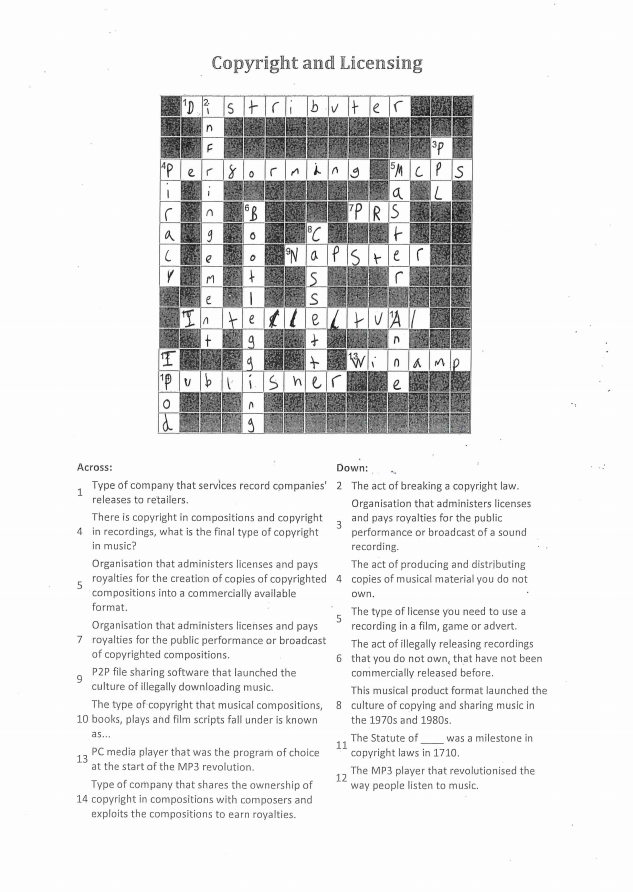
The lesson then went on to us discussing the copyright and licensing which is so much fun, we have to write an essay on the many terms, which is due in next week. so I’ll be working on that over the course of this week and going into detail on different posts…

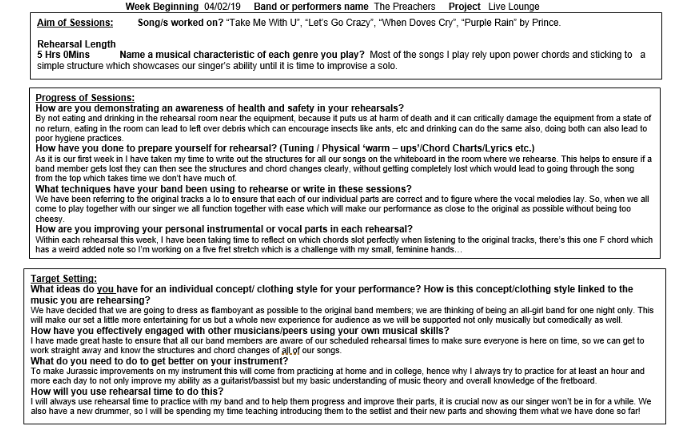
Rehearsal happened, what I am going to do is blame it on Monday’s, we went through “Purple Rain” with ease now, we started to tread through “Let’s Go Crazy” but my wrist has a great track history of trapping up and causing me incredible short and sharp pain which I tanked through which was not the smartest move but we have reached up to the solo, which I am secretly perfecting…

“When Doves Cry” is a song that I haven’t even contemplated looking at throughly yet, the beginning guitar lick is fun, but I can’t make it sound like the original which is annoying. Never the less, I am still listening to the album weekly so I have the structure nailed in the back of my head along with the vocal lines even though I am not singing it helps to know all of the Ques ahead of time.

“Take Me With U” is the only song we are having slight issues with as a band because it is heavily dependant on the vocalists to a stupid level which doesn’t help us out at all so in my head whilst we go through the song is Prince screaming “I don’t care where we go, I don’t care what we do”, its cool but yet again like be quiet voice in my head.

Our bassist wasn’t feeling too good today also so I insisted he left early to goto the doctors after we quickly went through our set, this has given me some time to organise my work and get back on task after the bullet in the head that was the beginning of the term!

Design a site like this with WordPress.com
Get started